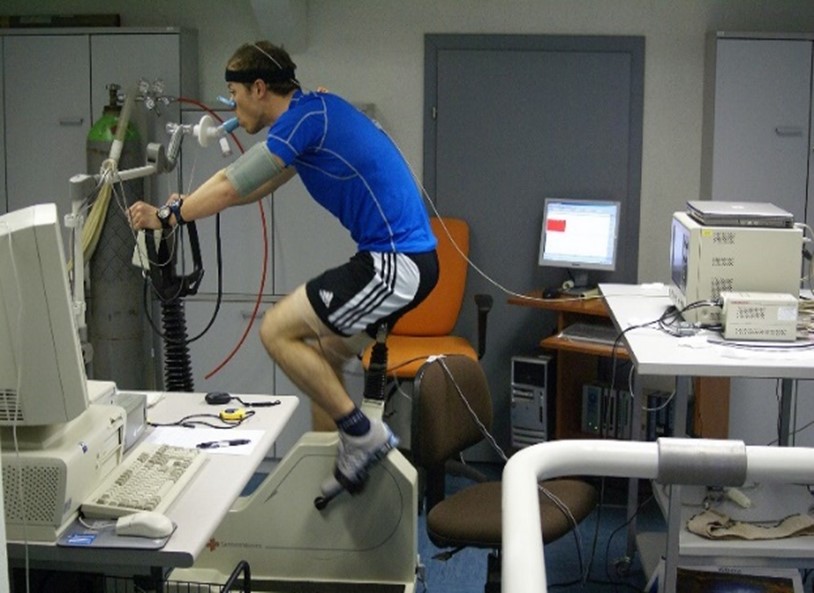
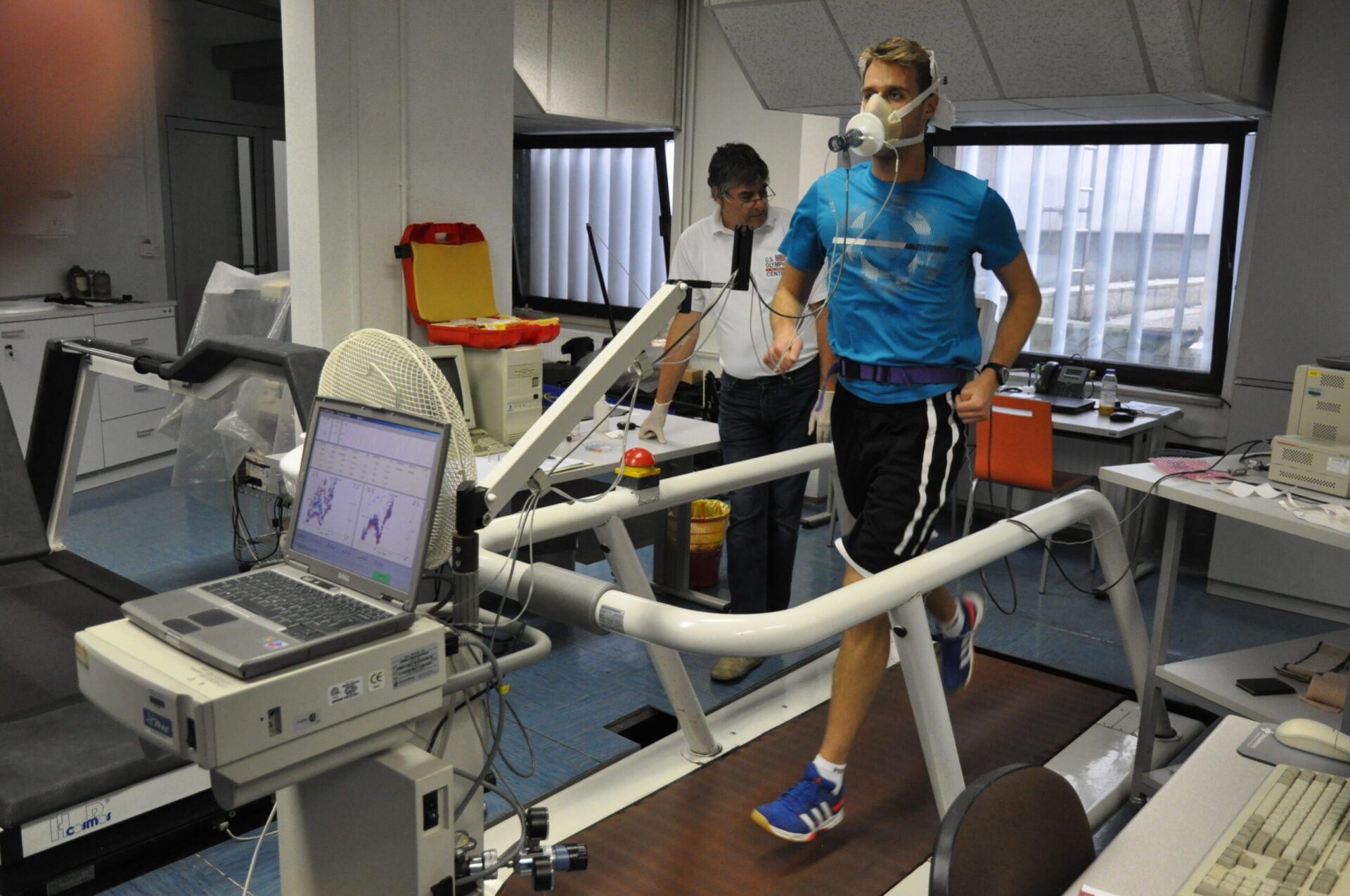

The “golden standard” for measuring whole body metabolism is endurance exercise in steady state metabolic conditions. This means that oxygen consumption (Vo2) and Carbon Dioxide production (Vco2) are relative stable during observed intervals of submaximal exercise. By using metabolic cart and classical metabolic equations:

and

It is possible calculating of the rate of CHO and FAT oxidation. Additionally, more complex and sophisticated approach in advanced ascertain of exercise metabolism is by using stable isotopes. The first contact and learning with such technology was in 1995 and 1996 during my post-doc visitation prof. dr. George A. Brooks at Laboratory of Exercise Physiology of University of California, Berkeley. The used technology was concentrated on 13C-Palmitate infusion during exercise on cycle ergometer and estimation of training effect on FAT metabolism. This was possible by estimating the oxidation rate of 13C-Palmitate by calculating 13CO2 oxidation rate from expired gases.
Photo berkeley visitation
Later, in the Laboratory of Biodynamic we have used naturally and artificially labelled glucose (13C-Glucose) depicted in figures below, for estimating glucose oxidation rate from drinking solutions during 2 h exercise on cycle ergometer at intensity corresponded by Lactate Threshold. Isotopes enrichment was measured by Europa 20-20 analyser (Department of Geochemistry, Jožef Stefan Institute). Oxidation rate of Glucose was thereafter calculated by standard equation:
The basic idea of using stable isotopes is to ascertain oxidation rate of CHO from drinking CHO solution and differentiate from oxidation from muscles glycogen oxidation rates. This was possible by measuring the difference between mass of the 12C and 13C atoms from exhaled CO2 samples. This was possible in specific conditions, which must be carefully realized before such experiment and during exercise trial.

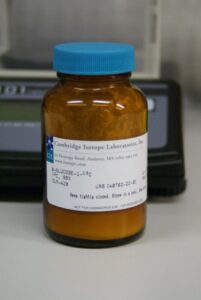
Our present work is related to the problem of the effect of ingestion NaH13CO3 (Sodium Hydrogen Carbonate labelled by 13C isotope) on acidosis during maximal swimming. Additionally, we are trying to ascertain more deeply the problem of NaHCO3 ingestion and preventing during high intensity exercise on cycle ergometer by using limited constant rate breathing frequency to simulate swimming respiration. Results are not available presently.