Part of the problem is the kinetics of oxygen uptake, which is determined by oxygen delivery by arterial blood on the one hand and oxygen transport by venous blood from muscle tissue on the other. Their complex model also appears to determine the kinetics of muscle oxygen uptake and the kinetics of muscle oxygenation. The latter is somewhat more complicated as the instruments are sensitive to several variables, e.g. subcutaneous muscle and fat tissue. On the other hand, the technology is currently relatively easy to handle, which in turn leads to a possible erroneous explanation of the results.
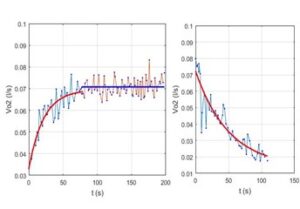
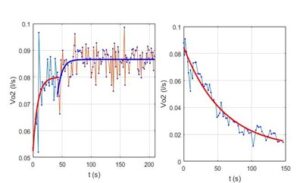
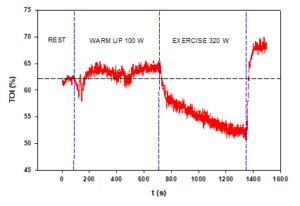
The oxygen delivery to the muscles is a part of the story that we also want to model. However, the major shortcoming in the construction of this model is the lack of measurements of cardiac output, which is the most important part of the model that uses the classical Fick equation as the basis for the time course:

However, when taking accurate venous samples to determine unutilised excess part of oxygen delivery, it must be seriously considered that the blood sample must be taken as close as possible to the muscle under observation. Therefore, the venous sampling catheters can be placed accordingly. Our best current limit is the classic venous blood sampling via a forearm catheter, which is far from our final goal: arterial and venous blood sampling from the leg.
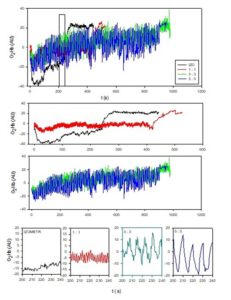
In spite NIRS technology allows limited information about muscle aerobic metabolism, forearm exercise is useful for observation muscle oxygenation fluctuations during isometric and dynamic contractions.
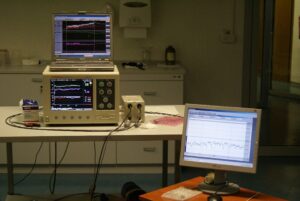
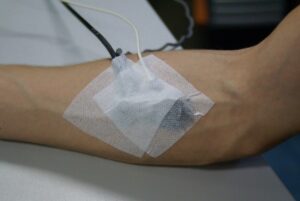
Comparison of isometric and dynamic contractions using different contraction frequencies at similar contraction force allow us to observe how different contraction frequencies and consequently mechanical works influence on muscle oxygenation. These results support the idea for further ascertain of muscle metabolism, for possible answer the questions what is the reason for different exercises performance during used exercises. This is possible by using Magnetic Resonance Spectroscopy.